,
India is the world’s largest democracy, but in reality, it has turned
into a ‘dynastic democracy’. There are many parties in India, National parties
like INC & BJP and regional parties like SP, BSP, AAP, DMK, TMC, TDP, RJD,
JDU, AIDMK and many more but all are playing dynasty politics. As a political
commentator aptly put it, “While the US is known for its presidential democracy
and Britain for its parliamentary democracy, India should be known for its
dynastic democracy.”

Whether such a description is good or bad is a different matter
altogether. What is for certain, however, is that at the Centre
and in the states, one ‘family’ or the other is playing dynasty politics,
with their footprints growing over time. One reality is also there like they
all are not coming directly but elected by public of india as per parliamentary
democracy. So its not bad but not ideal too.
Apologists argue that if children of lawyers and doctors can follow
their parents’ footsteps into a career, why one should object if the
progeny of politicians take up the same trade.
Congress vice president Rahul Gandhi posed this
question at a recent talk at the
University of Berkeley in the US, sending his detractors up in arms.
Information and broadcasting Minister Smriti Irani even called
Gandhi a “failed dynast”as per their fake ideology. She knows that BJP is also following dynasty
politics and still they blame INC. It called blind and arrogant attitude towards
nation.

The BJP has sought to put the Congress, led by the ‘first family’, in
the dock, with even new alliance partners, like Bihar chief minister Nitish
Kumar, joining in but barring the Left parties, almost all political parties
are participants in the dynasty game.
Actually BJP believes that Indians are fool and if they counting dynasty
of INC then people of india gives their vote and good behaviour towards BJP and
this type of thoughts will damage BJP in future because Indians are more smart.
Every time BJP leader and even PM Narendra Modi in rally and in private meeting
says about dynasty of INC but how can they forget about BJP dynasty.
If any party follow dynasty, they have to be elected as per democracy of
india then they can come to politics. So that’s the power of public who have
seen something unique and give chance so that is ideal. Nothing is wrong in
this. BJP hates this because they don’t believe in democracy and constitution.
BJP is full of dynasty politics
Despite the BJP crying hoarse about the Congress and dynasty politics,
the ruling party, and its alliance partners, is full of dynasts.

In Rajasthan and Chhattisgarh, the sons of serving BJP chief
ministers are MPs. Dushyant Singh, the son of Rajasthan chief minister VasundharaRaje,
is the MP from Dhaulpur, which his mother represented for many years.
Vasundhara’s sister YashodharaRaje is a minister in Madhya Pradesh. Her mother,
the late VijayarajeScindia, was an MP from Madhya Pradesh and was among the
founder members of the BJP. She was also associated with the erstwhile Jan
Sangh.
Vasundhara’s brother, the late MadhavraoScindia, was a Congress leader,
whose son JyotiradityaScindia is now the Congress chief whip in the LokSabha
and a prominent aspirant for the position of Madhya Pradesh Congress
Committee (PCC) chief, ahead of the assembly polls next year.

Similarly, Chhattisgarh chief minister Raman Singh’s son Abhishek is
also a LokSabha MP.
Former Himachal Pradesh chief minister and BJP leader Prem Kumar
Dhumal’s son Anurag Thakur is also a MP and had been an office bearer in the
BCCI.
Maharashtra chief minister Devendra Fadnavis is the son of the late
Gangadharpant Fadnavis, who was a member of the state legislative council. His
aunt Shobha Fadnavis was a Maharashtra minister.
Similarly, senior state BJP leader Eknath Khadse’s daughter-in-law
Raksha is a MP.

The daughters of the late BJP leader GopinathMunde, who was also
Maharashtra deputy chief minister, are in politics. His elder daughter Pankaja
is a senior minister in Maharashtra, while her sister Pritam has been elected
from Beed, her father’s constituency. Poonam Mahajan, Munde’s niece and the
daughter of the late Pramod Mahajan, is also a MP and head of the
BJP’s youth wing.
Union minister Jayant Sinha is the son of former finance minister
Yashwant Sinha, while UP MLA and BJP state general secretary Pankaj Singh is
the son of home minister Rajnath Singh and BJP MP Rajveer Singh is the son of
Rajasthan governor Kalyan Singh.
Tracing the Congress’s dynastic history
Rahul has followed in the footsteps of his family by joining the
Congress. His great-great-grandfather Motilal Nehru was the president of the
party, as were his great-grandfather Jawaharlal Nehru, grandmother Indira
Gandhi and father Rajiv Gandhi.
His mother Sonia Gandhi has been at the helm of the grand old party for
nearly two decades. She succeeded the late Sitaram Kesri in early 1998. Such
continued rule of a party by one family has seldom been seen in any other parts
of the world.

Rahul Gandhi became INC President and gave their contribution for
winning INC in Rajasthan, MP & Chhattisgarh and he has now given
indications that he is not averse to becoming the prime minister, if the
opportunity arises. His sister, Priyanka Gandhi Vadra, is often
considered the ‘most charismatic’ of the Gandhis at present and appointed
as a leader in east UP in 2019 election which is a master stroke of INC.
Fadnavis’s predecessor from Congress, Prithviraj Chavan, also hailed
from a political family. His father Anandrao Chavan was Union minister in
Indira Gandhi’s rule, while his mother Premalakaki was later the Maharashtra
PCC Chief. Prithviraj Chavan’s predecessor was Ashok Chavan of the Congress.
Ashok, who is currently the Maharashtra PCC chief is the son of the late S.B. Chavan,
a former chief minister and Union home minister.
INC party built india and his contribution to build india is phenomenon.
No one has dare to ignore it except BJP and their blind followers because they don’t
believe in equality, liberty and fraternity of Indian Constitution and BJP
always showing their arrogance and dictatorship towards Indians.
Dynasty in regional parties
Many regional parties have also found themselves controlled by some
political families. Be it the Telugu Desam Party (TDP), TelanganaRashtraSamithi
(TRS), Indian National Lok Dal (INLD), RashtriyaLok Dal (RLD), ShiromaniAkali
Dal, Samajdwadi Party, RashtriyaJanata Dal (RJD), Peoples Democratic Party
(PDP), National Conference, BijuJanata Dal (BJD) and even the Jharkhand
MuktiMorcha (JMM), the family not only matters, but also calls the shots.
Nearly two dozen people related to Mulayam Singh Yadav hold some
political position or the other. His son Akhilesh was the chief minister of
Uttar Pradesh for five years, while his brother was a senior minister in the
state for several years. Of the five MPs of his party, four are from his
family, including his daughter-in-law Dimple Yadav.

RJD leader Lalu Prasad Yadav too has many family members in
politics. In fact, when the fodder
scam threatened his chief
ministership, he brought his wife Rabri Devi in his place. One of his sons,
Tejaswi, served as Bihar’s deputy chief minister until recently, another
was a senior minister in the state, while his daughter MisaBharati is a
RajyaSabha MP.
Ram Vilas Paswan, whose rise, like that of Mulayam and Lalu, is
linked to the Janata Party days, is a minister in the Narendra Modi government.
His son ChiragPaswan and brother RamchandraPaswan are among the handful of MPs
of the LokJanshakti Party party while his other brother, PashupatiPaswan,
is now a minister in the Nitish Kumar government in Bihar.
Down south, Tamil Nadu has seen political families flourish. M.
Karunanidhi has been the chief minister several times. His son M.K.
Stalin is currently the leader of the opposition in the state and is seen
as a future chief minister.
Tamil Nadu also boasts of the legacy of M.G. Ramachandran, whose wife
Janaki became the chief minister after his demise but subsequent elections saw
Jayalalithaa take forward his political legacy.
The issue of Telugu pride brought superstar N.T. Rama Rao from the green
room of the film studio to the room heading the undivided Andhra Pradesh
cabinet in the early 1980s by forming the TDP. His son-in-law and current
Andhra Pradesh chief minister N. Chandrababu Naidu took forward this political
legacy. His son Lokesh is the rising star in the state cabinet.
Similar is the story in neighbouring Telangana. The son of TRS leader
and chief minister K. Chandrasekhar Rao, K.T. Rama Rao, is seen as the
rising star in the party. His daughter Kavitha is also a LokSabha MP.
Andhra Pradesh is home to another political family. Y.S. Rajsekhar Reddy
of the Congress became the state strongman when he became chief minister in May
2004. He retained power in 2009 but passed away soon after in an accident. His
son Y.S. Jagan Mohan Reddy has since left the Congress and has floated his YSR
Congress Party.
In Odisha, BJD leader and chief minister Naveen Patnaik is carrying
forward the legacy of his late father and Janata Party stalwart Biju Patnaik.
A colourful personality, Bijuda started his politics from the
Congress and later moved to the Janata Party. His legacy is so great that
although Naveen was not in politics when his father died and does not know much
Oria, he had been the undisputed leader in the state for nearly two decades.

In Punjab, the Parkash Singh Badal family controls the ShiromaniAkali
Dal, which ruled the state until recently. Parkash’s son SukhbirBadal
served as the deputy chief minister. Sukhbir’s wife, Harsimrat Kaur, is the
Union minister for food processing.
Punjab chief minister Amarinder Singh also heads a political family. His
wife Prenit Kaur was a Union minister in the UPA government while their son is
also in politics.
In Maharashtra, the Shiv Sena has remained in the control of the
Thackeray family. Founded about 50 years ago by Bal Thackeray on the ‘son
of the soil’ issue, the Sena is now lead by his son Uddhav while his
grandson Aditya heads the youth wing. The party split, with nephew Raj
Thackarey forming the Maharashtra Navnirman Sena when he realised that the
uncle is passing the baton to his son.
Nationalist Congress Party supremo SharadPawar also heads a political
family. His daughter SupriyaSule is a MP while his nephew and former deputy
chief minister Ajit Pawar is an MLA from the Baramati assembly segment.
In Goa, former chief minister Pratapsinh Rane’s son Vishwajeet is also
in politics.
Jammu and Kashmir chief minister Mehbooba Mufti is the daughter of the
late Mufti Mohammad Sayeed, founder of the PDP and a former chief
minister. Mufti’s predecessor as chief minister was Omar Abdullah, grandson of
the late Sheikh Abdullah and son of National Conference chief Farooq Abdullah.
In Karnataka, former Prime Minister H.D. DeveGowda of the Janata Dal
(Secular) has sought to carve out a niche for his family amid the tussle
between the Congress and the BJP. His sons H.D. Kumaraswamy and H.D. Revanna
are active in politics with Kumaraswamy also being the chief minister like his
father.
In West Bengal, chief minister Mamata Banerjee is being accused by her
detractors of promoting her nephew Abhishek Banerjee in the ruling Trinamool
Congress.
Meanwhile in Uttar Pradesh, Bahujan Samaj Party (BSP) supremo Mayawati
is now promoting her brother Anand Kumar and nephew Aakash in the party to
boost its fortunes.
Dynasty a theme in Indian politics
There are many examples of political families ruling the roost across
the states but digging deeper shows that the malaise goes as far as the
village level too.
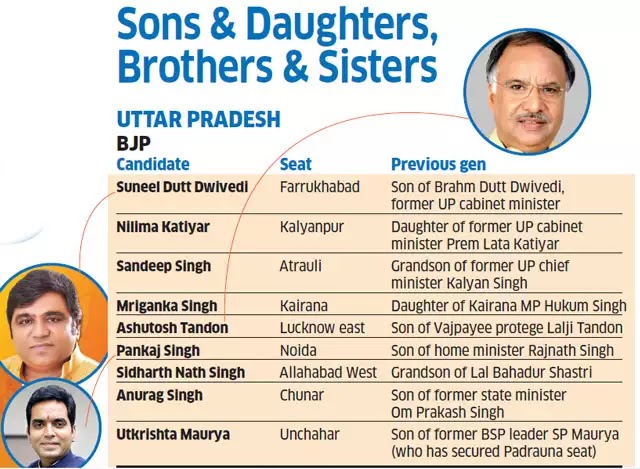
The BJP may cry foul over the Gandhi family, but if it was truly against
the dynasty culture in Indian politics, it would not have allowed ‘political
families’ to proliferate in its own backyard. Interestingly, to checkmate
the Gandhis, the BJP brought in Maneka Gandhi and her son Varun.
This ‘dynastic culture’ in Indian politics is no longer a mission but a
profession. The priority of present-day politicians isn’t service to
the nation. Often, it is the quest for power that brings them into politics. To
hold on to power, the politician finds nothing better than promote their own family.
Until Indian democracy matures, people will have to put up with
dynasties whether they like it or not. A state funding of elections could bring
in more fresh blood in the system with new ideas and new aspirations, without
the family tag.

Indian politics is passing through a transition and ‘promoting the
family’ appears to be an invariable part of it right now. The Congress will
continue to be under attack on the ‘family’ issue until it takes steps to bring
in new leaders at all levels.
Vice president M.
Venkaiah Naidu’s remark that “dynasty is nasty” has, in one stroke, condemned all political
parties practicing, including the BJP.
So Indian youth should come into politics and destroy this dynasty
politics of all party in india which is Dhrutrashtra
Syndrome at all.
For Best and Secret Deal of the Decade, Click on below Sites: