Friday, October 5, 2018

,

Around 2 year ago, on Nov. 08 2016, Prime Minister Narendra Modi’s announcement that INR 500 and INR 1,000 notes were going to be taken out of circulation overnight predictably led to utter chaos and mayhem. Not only a flustered public, even the government and India’s central bank were caught flatfooted. Some 74 notifications were issued in 50 days following the note-ban announcement, several involving an about-face on the previous announcements. And in the months that followed, about 1.5 million jobs were lost, business in several cash-intensive industries came to a screeching halt, and economic growth took a beating. 2 year later, the jury is still out on whether Demonetization was worth it.


The Reserve Bank of India’s report revealing that about 99% of the demonetised notes had been returned further muddied the waters. This basically meant that the amount of black money in the system was far lower than previously estimated. The government, meanwhile, is out to convince everyone of the resounding success of this exercise, which was variously aimed at curbing black money in the system, improving the digital economy, and tamping down on terrorist funding. Its supporters are celebrating that day as “anti-black money day,” while opposition parties call it”Dhokha Divas“—a day of treachery. BJP is doing comedy and showing their cheapness by celebrating that day.

As the debate rages on, this is how Demonetization has impacted the Indian economy and the country’s banking system:
For one, the note ban sent the economy into a tailspin. Even though the government has been trying to argue otherwise, several institutions, including the Wold Bank, have cut India’s growth forecast for this year. This slowdown may have to do with factors other than Demonetization, too, but the withdrawal of high-value notes did hit hard.
Narendra Modi told that give him 50 days and if he failed & wrong then burn me alive. This type of statement spread violence in our society and excited public. So this is wrong and showing his arrogance. Today we all know that Modi’s statement was bullshit and Shameful and public are speaking bad words for Narendra Modi.

Even Subhramanium Swami blamed Modi Government for changing number of GDP by own. This type of behaviour is not acceptable in democracy. They are trying to dictate people. In which direction Modi government is going on? If this type of foolish decision continue, BJP will crush India again as done by Britishers earlier.


The cash ban also took a toll on industrial production, which measures India’s factory output. Small and medium enterprises (SME) bore the burnt, as these firms relied heavily on cash. A year on, many are still struggling to get back on their feet. Many SME closed so badly like never before. Many people lost their job immediately within month after Demonetization. Youth of India was very angry with Narendra Modi because of their immature decision without proper planning.

As the economy slowed down, jobs disappeared. Some estimates suggest that about 1.5 million jobs were lost in the aftermath of Demonetization between January and April 2017 and still in 2018 many people are jobless. The labour participation rate (LPR), which shows the share of the population that is employed or willing to work and looking for jobs, also crashed in the wake of Demonetization. And it still hasn’t recovered fully.


Unsurprisingly, a sluggish economy and vanishing jobs did nothing to help consumer sentiment in India, which has gone on a bit of a roller-coaster ride since November 2016. Below is the consumer sentiments index, which is based on a survey of about 42,000 households every month.

The government also claims that there has been an increase in the number of people that have come into the tax net, but the final numbers from the Central Board of Direct Taxes are still awaited. Meanwhile, there has been a crackdown on shell companies—bogus entities set up to launder money and evade taxes—with the income tax department taking action against 1,150 of these firms. Every year there is increase in tax submission by people so that is not benefit of demonetization.
Prime Minister declared from ramparts of red fort that 3 lakh crores black money has been identified and his own ministers in successive replies to parliament have said that amount of undisclosed income and undeclared income is not more than 28,000 crore. What the rubbish is going on?

Earlier in the day, the RBI, in its annual report, said that out of Rs.15.41 lakh crore Specified Bank Notes (SBN), Rs.15.31 lakh crore has been recovered, thus indicating recovery of 99.30 per cent of demonetised currency.


Even the Bharatiya Mazdoor Sangh (the labour wing of the governing Bharatiya Janata Party) admitted: "As many as 250,000 units in the unorganised sector were closed and the real estate sector was badly affected, with a large number of workers losing their jobs."
Agriculture, a sector which largely operates on cash, was hard hit too, with farmers not being paid enough for vegetables and pulses they had grown. Many protested and several state governments waived payments on farm loans.
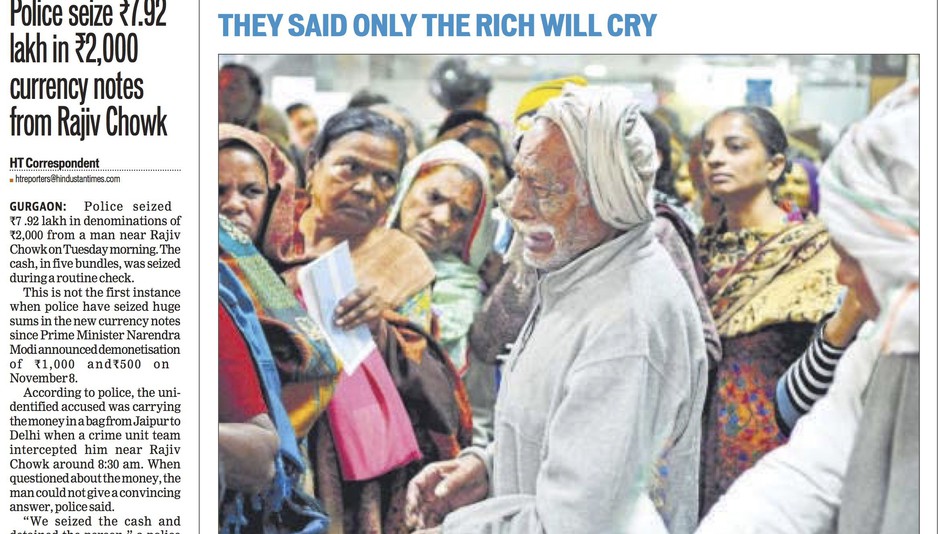
Over and above this, the government's policy caused a huge cash shortage, with people having to spend many days standing in ATM lines trying to withdraw their own money. 150 People even died in this process. Details of deaths are mentioned below:


Narendra Modi told in lectures that Rich people are crying due to demonetization but reality is poor are crying and died due to irregularity in family. BJP Minister told in public that those who died in demonetization are thief. This type of mentality of BJP is shameful.
Venezuela Government reverted the decision of demonetization after just 1 death and in India 152 died due to demonetization but Modi government did not care about it and continue showing his arrogance and insensitivity towards Indians.


Demonetization is big mistake of Modi Government so we can say it’s a big crime of government they done with Indians. Narendra Modi should come to public and he must say BIG SORRY to public for Demonetization.

Indians are not fool and they are ready to give answer of Demonetization in 2019 so in future No one can take this type of Bullshit & Cruel Decision.


INDleak: Modi Government done Demonetization to convert Black Money to White Money of BJP leaders and Big Industrialists.

If you want to add something then you are welcome.

Disclaimer: We don't want to hurt any Person or Community by this Post.


Wednesday, October 3, 2018

,

Where we go if World War III happens? Our world is on the verge of World War III with ensuing terrorism covering over half of the globe, depletion of natural resources; such as water, oil, influentially biased and war-minded leaderships of the superpowers; And the uprising tensions between countries such as Russia and Ukraine, North Korea and South Korea, India with Pakistan and China. Despite this, there are some highly neutral countries which might be left alone & where we can go if Word War III ever breaks out. People are now wondering where the best countries to hide out would be if World War III fears come true.
These are 11 Safest Countries where we can go if WW III happens.
11. Australia
Australia is a country and continent surrounded by the Indian and Pacific oceans and it has large number of natural resources and army. Australia is surrounded by ocean so no one can enter in land directly. Enemy has to come by water path and that gives enough time to defend. Australia spends more budget on defence so its army power are amazing. It has 12th largest defence budget in the world. Hidden machinery of army and activeness of military made it safe country to stay during WW III.

10. Tuvalu

Tuvalu lies within the vast expanses of the Pacific Ocean. It is an extremely secluded and politically non-aligned nation due to its isolation and neutrality. It has a small population with negligible resources giving the major countries involved in the world war absolutely no objective to attack it. Moreover, unlike other island nations; Tuvalu’s people are uniquely self-sufficient i.e. they produce their own food according to their consumption, and other necessities according to the requirements. So, they will probably be left alone in a war scenario and make it safe to stay.


9. New Zealand

New Zealand is another sequestered, yet developed nation, with a stable democracy and no history of gory war conflicts. Its friendly foreign policy gained fourth spot in the Global Peace Index. Much like Tuvalu, it is capable to support itself in short term. As it has fertile soil and clean water and it produces its own food. It has more number of hydro electrical plant which gives 50% of energy if all sources are stopped. Moreover, its mountainous terrains shall provide shelter if ever it falls in the brink of invasion. But, most likely it will be just left alone having nothing to do with the outside world at war.


8. Switzerland

Switzerland has no interest in war after napoleon. Although Switzerland shares its borders with Germany, France and Italy which are likely to take active part in the World War III. But, nukes will not be landing on Switzerland due to its tough mountainous terrain, staunch traditional neutrality, and with a slight humorous touch, Swiss Bank! Switzerland has also undoubtedly proved itself to be a safe haven during Europe’s bloody past. And, even if the nukes somehow ended up landing there, most of the Swiss populace is heavily armed with bunkers all around the territory not to mention the mountains shielding them from the neighbour war-torn countries.


7. Bhutan

Seeing Bhutan in this list might be surprising because it shares borders with three potential World War III combatants, India, Pakistan and China. But the truth is that its unique location and landscape provides it with an excellent shelter through any apocalyptic disaster. Bhutan being surrounded by the Himalayas makes it landlocked and concealed enough to be left unscathed. Moreover, since the country has joined the United Nations in 1971, it has maintained a Swiss like disinclination from any kind of foreign intertwining and having no diplomatic relations with the United States as well. Only India and Bangladesh have their embassies in Bhutan’s capital making it just illogical to invade it.


6. Chile

Chile is far from nuclear power countries. Chile is one of the most flourishing and moored nation in South America with human development ranking higher than any other Latin American nation. It becomes almost impenetrable from the west of its borders where the Andes Mountains encompass it. From the atmospheric point of view, since it is situated in the Southern Hemisphere, it tends to have less pollution than the Northern Hemisphere because of being less populated and less industrialized. Added to this, Chile’s air masses is continually replenished by the Antarctic. So it may stay cleaner than the nations to its North adulterated by war.


5. United States


USA is No. 1 Super power in the world and it has Anti-missile defence system so no one can dare to attack on USA. While it’s purely speculation, Listpedia warns there are many unknowns about military systems and technological development in the USIt’s highly likely there are a large number of hidden fallout bunkers across the country to provide shelter. Conspiracy theories abound that the US possesses secret super technologies, such as weapons or shields, to use if the situation arises. If it does possess something of this nature, it could destroy its enemies while remaining intact. 

4. Malta

Malta is a tiny island nation which floats in the Mediterranean Ocean. It is a fortress, which from being a Crusader state to the World War II, has been failed from being captured by several empires. Its topography makes it extremely expensive and tough to be invaded by infantry or through the sea. In addition to that, due to it being relatively small, no country will waste an entire nuclear missile on it! So ultimately in the end, it shall just be ignored by the major combatants of the WW III.


3. Ireland

Even if Ireland lies right next to the biggest world war competent, England, it tends to a totally independent foreign policy and therefore, is not a member of NATO with having a long standing military neutrality. It has no strong knots tied with other potential World War combatants either. According to Irish policy, if they ever had to enter any outlandish military conflicts they will have to need an approval from the Irish government and Legislature as well as the United Nations. Now that is a pretty sly but a wisely neutral policy!


2. Fiji

Fiji made up of 332 islands. Fiji is another isolated island nation located in the deep Pacific Ocean. It has a small population with a peaceful foreign policy with no huge amounts of resources. Thus, holding no threat to any nation, therefore, making it a non-justified no-go area for the potential invaders. Fiji has been supporting human settlements since hundreds of years. And it could definitely manage some more in a case of world war!


1. Iceland

Iceland is country so peaceful and neutral, that it was ranked number 1 in the 2015 Global Peace index. It does not share its border with any other country and is distant enough from the rest of the world. It has 85% Hydro electrical energy and Solar so it does not depend on others. Besides, it has a mountainous terrain to take refuge in the worst case scenarios, nonetheless, initially this place is likely to be left alone even though missiles keep bombarding on the other countries.


So these are the Top 11 safest countries where you can go with trust so if WW III happens, go and save yourself and your family.
Please Like, Share and Comment if you want to add something.


Sunday, September 30, 2018

,

Since the time, people started using money, there have been numerous cases of scams and frauds because money can do anything. History shows that scammers are expert in preying on people’s gullibility. But even after stealing millions, the future for these people does not bode well, and usually, their frauds are exposed around world. In this article, we have collected the 11 biggest scams in history which left the investors poor and sometimes even destroyed entire economies.

1. Rafale Scam
In 2007, India began the process to buy a fleet of 126 Medium Multi-Role Combat Aircraft (MMCRA) after the defence ministry, headed then by Congress leader A K Antony, cleared the proposal from the Indian Air Force (IAF). After a long process, bids were opened in December 2012 and Dassault Aviation emerged as L1 (lowest bidder). In the original proposal, 18 planes were to be manufactured in France and 108 in India in collaboration with the Hindustan Aeronautics Ltd. There were lengthy negotiations between the then Congress government and Dassault on prices and transfer of technology. The final negotiations continued till early 2014 but the deal could not go through. Details of the negotiated price per Rafale deal were not officially announced, but it was suggested by the then Congress government that the size of the deal would be $10.2 billion. The Congress claimed that per aircraft rate including avionics and weapons was zeroed in at INR 526 crore.

In 2014, Modi government came in power. During PM Modi visit to France on April 10, 2015, he announced India will purchase 36 Rafale jets in a government-to-government agreement as per his arrogant belief. After the announcement, questions were raised by the Opposition on how the PM finalised the deal without the approval of the Cabinet Committee on Security.
A joint statement issued on April 10, 2015, after talks between Modi and then French President François Hollande, said they agreed to conclude an Inter-Governmental Agreement for supply of 36 Rafale jets on terms that would be better than conveyed by Dassault Aviation as part of a separate process underway. The statement said the "aircraft and associated systems and weapons would be delivered on the same configuration as had been tested and approved by Indian Air Force, in clear reference to negotiations and testing process for the Rafale jets under the Congress government.
India and France signed Euro 7.87-billion (INR 59,000 crore approximately) deal on September 23, 2016 for 36 Rafale jets. Additionally, an accompanying offset clause was sealed through which France will invest 30 per cent of the 7.8 billion Euros in India's military aeronautics-related research programmes and 20 per cent into local production of Rafale components.

PM Modi even did not say why only 36 Rafale jet instead of 126 jet as per requirement of Indian Air Force. So all Opposition and specially Congress smell up corruption in deal and asked Modi to discuss all details about deal but he refused as usual.
Reliance ADAG would have involved in the deal and operated as per Narendra Modi’s advice. Even Ex France President Hollande revealed that Narendra Modi told us to give contract to Anil Ambani group. So clear cut Scam of 37000 Crore of Narendra Modi Government which is so big.


2. In 1996, a Canadian mining company, Bre-X, announced a huge discovery of gold, and in the process went from a penny stock to $280 per share, with a total value of $4 billion. In reality, it was all a fraud and the lead geologist was shaving off gold from his wedding band to add to drill-core samples.


Image Source: www.911metallurgist.com

During the late 1990s, Geologist John Felderhof believed that a property near the Busang River in Indonesia would produce gold after mining. At his advice, David Walsh, the founder of Bre-X Minerals Ltd., bought the property. The project manager of the gold mining project was Filipino geologist Michael deGuzman. When deGuzman tested the initial samples, he didn’t find any trace of gold, so he shaved off some gold from his wedding band, added it to the samples, and declared the first estimate of the total find to be about 62 metric tons. The news of the presence of gold in Bre-X’s property soon spread like wildfire. The company claimed that it was going to be the richest gold mine ever discovered. Mining investors rushed to invest and the stock price of Bre-X started climbing, and it rose from pennies to $280 per share.
Michael deGuzman kept on salting the samples, and that worked until 1997. In 1997, the Indonesian government got involved, and from February 1997, the evaluation of the site began. In March 1997, deGuzman committed suicide by jumping from a helicopter. Bre-X and its mine’s reputation started going downhill from then on. On March 26, 1997, an American firm announced that its core sample collected from Busang contains a negligible amount of gold. As a result, the Indonesian government postponed signing the mining deal with Bre-X. Stock prices began to fall, and thousands of investors lost billions. TSE and NASDAQ suspended trading of Bre-X stock, and it went bankrupt on November 5, 1997.


3. Founded in 1985, the Enron Corporation claimed revenues of nearly $101 billion during 2000 and employed approximately 20,000 staff. But the real value of the company was exposed at the end of 2001, after which the company was declared bankrupt. Enron was responsible for wiping out over $78 billion in stock market value.


Image Source: www.entrepreneur.com

The American company Enron came into focus after 1996 when it began reporting a steady increase in its sales each succeeding year. From 1996 to 2000, the sales of Enron was reported to increase from $13.3 billion to $100.8 billion. It was declared as “America’s Most Innovative Company” by Fortune magazine for six consecutive years. But at the end of 2001, the actual financial condition of Enron was revealed to public. The report stated its accounting fraud, also known as the “Enron Scandal,” and the company filed for bankruptcy in 2001.

The Enron Scandal revealed the loopholes in accounting rules in America. The company used to book revenue from huge energy-derivative contracts at their gross value instead of their net value. Basically, Enron served as a middleman on deals. It would put together a seller with a prospective buyer and take “delivery” of the contract. Then it would book the entire “sale” as its own revenue. This was made possible due to a loophole in the procedures approved by the Financial Accounting Standards Board (FASB). According to the board, each company had a “free option” as to how to account for the deals of energy contracts.


4. In 1821, a Scotsman, Gregor MacGregor, invented a fictional Central American republic called “Poyais” and convinced hundreds of people in his home country of Scotland to invest in the non-existent country, and even oversaw the deployment of a ship of 250 people hoping to start a new life in Poyais. When their ship arrived, they found nothing but undeveloped, inhospitable jungle.


Gregor MacGregor was born in 1786 at Glengyle, Scotland. He carved out a place for himself in history by pulling off one of the biggest frauds of the early 19th century, gaining over £200,000 in the process. In the early 1820s, McGregor invented an entirely fictional country and named it “Poyais” He claimed it was located near the Black River in what is now present-day Honduras. McGregor claimed that Poyais covered eight million acres, and he was the prince of this land. He also claimed that the land was rich in natural resources but required manpower to turn it into a developed country.
MacGregor began an aggressive campaign to make people believe in his fictional country. He printed advertisements and leaflets and gave interviews in national newspapers. He even had Poyais-related ballads composed and sung. In mid-1822, a 355-page Poyais guidebook was being sold in London and Edinburgh which contained elaborate maps and details about this fictional country. The official-looking book convinced many people, and they started buying Poyaisian land certificates. By early 1823, about 500 people had bought Poyaisian land.
After that, McGregor began making arrangements to send interested people to Poyais. On 10 September 1822, a vessel with 70 emigrants on board sailed towards the non-existent country. Later, on 22 January 1823, another vessel sailed with almost 200 emigrants aboard. Upon reaching the land which was they believed to be Poyais, the emigrants realized they have been duped. Few travelers were able to return, and most of them died due to diseases like yellow fever and malaria. So it was dangerous for them.


5. In the early 1990s, the infamous Italian criminal Charles Ponzi scammed investors out of about $7 million by passing on new investors’ money to existing investors and presenting it as a sustainable investment.


Image Source: commons.wikimedia.org

In the summer of 1919, Charles Ponzi was living in Boston. The idea for a scam began forming in his mind when he received a letter from a Spanish company. The letter contained an international reply coupon (IRC). This coupon could be redeemed by the recipient for postage to the sender’s country. Ponzi realized that he can buy the coupon in one country and then exchange them for postage in another country with a higher value of postage. Soon, he set his plan into motion, but he required a large amount of capital to buy the IRCs with cheap, European currencies.
To raise the money, he went to his friends and promised them double returns in 90 days. Some people invested and they got the interest as promised. In January 1920, Ponzi opened his own company to promote this scheme. In the beginning, 18 people invested. They got the promised interest the next month. As word spread about this unbelievable scheme, investments started pouring in.
By June 1920, the net total investment in Ponzi’s scheme rose to $2.5 million. People began mortgaging their homes and even invested their life savings in the scheme. But no one realized that Charles Ponzi was paying the earlier investors with the money invested by new investors. Ponzi’s rapid rise drew suspicions, and his publicity agent found incriminating documents related to the scam. The agent wrote an article for the Boston Post which brought Ponzi’s scam into public view. From then on, things went downhill for Charles Ponzi, and his investors lost about $20 million. In November 1920, Ponzi was sentenced to five years in prison. So we have to aware from this kind of scheme. There is no shortcut in life to become successful.

6. After buying the financial institution Lincon Savings and Loan Association, Charles Keating began investing savers’ cash in high-risk ventures without informing the depositors. The scam was revealed in 1989 after the business failed leaving thousands of elderly investors with worthless bonds.
Image Source: www.nytimes.com

Charles H. Keating was a champion swimmer, activist, lawyer, banker, and real estate developer. But the thing he is most known for is his role in the savings and loan scandal of the late 1980s. Charles Keating became the head of Lincoln Savings and Loan Association in 1984. Immediately after joining the enterprise, he fired the existing management. During those times there were quite loose restrictions on banking investments. Taking advantage of this opportunity, Keating began investing depositor’s money in high-risk investments. For the next four years, Lincoln’s assets increased. It rose from $1.1 billion to $5.5 billion.
In 1989, Lincoln Savings’ parent company, American Continental Corporation, went bankrupt. The day after American Continental Corporation went bankrupt, Federal authorities seized Lincoln Savings. The scam left 23,000 customers with worthless bonds.

7. In 1925, a Portuguese named Alves dos Reis forged a government contract authorizing him to print money and “officially” printed himself 100 million escudos, the equivalent of 0.88% of Portugal’s GDP at that time, leading to the “Portuguese Bank Note Crisis.”


Image Source: commons.wikimedia.org

In 1924, Alves dos Reis was in jail for embezzling money from a company. During his 54-day stay in jail, he planned a scam which later came to be known as the “Portugal bank note affair.” After being released from jail, Reis forged a contract in the name of the Central Bank of Portugal, Banco de Portugal. Then he posed as a representative from the bank and convinced a London-based company that the bank had authorized him to print his own bank notes. Reis further claimed that the money they were going to print was a part of a secret project, and it would be used to financially aid a struggling Portuguese colony, Angola.
According to Reis’s instructions, the London-based company printed an equivalent of £1,007,963 of bank notes. The notes were then circulated into the Portuguese economy. In June 1925, he created the Bank of Angola & Metropole to help Angola. He even went on to buy the controlling interest in the Bank of Portugal following which he hoped he would be able to successfully hide his scam. But the low-interest rates of the Bank of Angola & Metropole piqued the interest of journalists, and they raised questions. Finally, the Bank of Portugal noticed the bank notes with duplicate serial numbers, and Reis’s scam was exposed. Five years later, he was sentenced to 20 years in jail.

8. In the 1920s, Ivar Kreuger, who owned banks, film companies, newspapers, mines, telephone companies, and railways, decided to form a monopoly to control all the world’s safety matches. International banks begged him to let them invest, not knowing that his many companies existed only on paper, profitable only because they were invested in each other.
Image Source: en.wikipedia.org

The Swedish civil engineer Ivar Kruger began his career by helping in building New York’s Plaza Hotel and other landmarks. After gaining experience, he opened a company in Sweden in 1908. His company soon became the best construction firm in Sweden. Then Kruger took over his father’s match business. In 1917, he founded the Swedish Match Company. In the post-depression era after WWI, Kruger began to acquire match-making factories around Europe.
From 1925, Kruger began offering loans to insolvent countries at a bargain that was hard to refuse. He would also provide loans to countries that offered him a national monopoly on match production. Using his skills, he increased the sales in the country. Since the governments taxed matches, the increase in sales would increase tax revenues used to repay the loans. By 1931, the Swedish Match Company controlled 250 factories in 43 countries. But his empire collapsed during the Great Depression. On 12 March 1932, he committed suicide by shooting himself.
The death of Kruger led to the “Kreuger crash.” It hit investors and companies all over the world, especially in America and Sweden. After his death, Kreuger’s forgery of Italian bonds amounting to $142 million was found out. In Sweden, Kruger owed more than the country’s national debt. As a result, the suicide rate increased in Sweden and the prime minister fell. In America, his shares collapsed taking with it the life savings of thousands of people.

9. Nigerian scammer Emmanuel Nwude once sold a fake airport to a major international bank for $242 million, and the scam wasn’t discovered until 3 years later.

Emmanuel Nwude is a Nigerian fraud artist who was formerly the Director of Union Bank of Nigeria. In 1995, he defrauded a Brazilian man, Nelson Sakaguchi, who was the Director at the Brazil’s Banco Noroeste. Nwude began his scam by impersonating the then Governor of the Central Bank of Nigeria, Paul Ogwuma. Posing as the governor, he convinced Sakaguchi to invest in a new airport located in Nigeria’s capital, Abuja. In exchange, he asked for a $10 million commission.
The fraud remained undetected until 1997 when a Spanish bank decided to take over the Banco Noroeste Brazil. When an official from the Spanish bank enquired about the large sum of Noroeste’s money which was sitting in the Cayman islands unmonitored, it led to a criminal investigation. It was found that Sakaguchi had paid $242 million in between 1995 to 1998 to Emmanuel Nwude who promised him an airport which actually never existed.

10. When “Count” Victor Lustig discovered that the famous Eiffel Tower was in need of repairs, he faked some government papers and sold the tower to scrap metal dealers twice with a total of over $200,000 in bribes to throw the multi-million dollar contract their way.
Image Credit: Jeff Maysh via www.smithsonianmag.com

Victor Lustig began his conman career through a “money-printing machine.” The machine would produce a counterfeit bill of $100. His client would buy the machine for a high price believing that it would provide them with huge profit in the future, but the machine would produce $100 bills only for the next 12 hours after which its supply became exhausted resulting in blank notes. By the time the person realized the scam, Lustig was long gone and hidden somewhere.
Lustig’s sale of Eiffel Tower began in 1925 when he read about a repair and maintenance of the tower in a newspaper. He invited six scrap metal dealers and posing as a government official said that Eiffel tower would be taken down. Then he asked them to submit a bid and finally secured a deal with one of the dealers. For finalizing the deal, scrap dealer Andre Poisson offered a large bribe and secured the deal. After receiving the money, Lustig went away and Poisson was too embarrassed to lodge a police complaint. A month later, Lustig returned back to Paris and repeated the same trick. His second victim knew everything and directly went to the police, but Lustig evaded arrested.

11. From 1997 to 2002, over 4,000 people paid an advance fee in order to receive new cars at a fraction of their value. The cars supposedly came from the estate of a wealthy Christian man according to his will. The scheme took in over $ 21 million, but neither the deceased, his alleged will, an estate of any kind, or the cars ever existed.
Image Source: www.highlineautomotive.in
The “miracle car scam” began with a story circulated by a man named Robert Gomez who claimed that he was the adopted son of John Bowers, a wealthy executive of a food company. Three years later, just before Christmas Bowers claimed in his church that he is now the heir of Bowers’ estate which is valued at $411 million. He also said that Bowers had instructed in his will that a fleet of 16 luxury cars would be given to fellow believers as a “gift.” The beneficiary needed to pay an amount of roughly $1,000 to $1,100 as a conveyance fee for each vehicle. The news spread through word of mouth and many church members showed interest in the deal. People started depositing the conveyance fee, and in a course of four years, from 1997 to 2002, 4,000 people deposited the advance fee.
The staggering number of car sales aroused suspicion, and an investigation was launched. Investigators found out that a man called John Bowers, as described, never existed and neither did his estate or cars. It was also revealed that in 2002, Gomez, along with his accomplice, had collected $21.1 million from people. In 2003, he was sentenced to 21 years and 10 months in federal prison.

So this types of Scam done by scammer and cheated publics and government so be aware and spread awareness. Be active & don’t show your so much trust to anyone because this type of trust sometimes becomes Scam.

If you know other big Scam then comment and share your idea and aware world.

Disclaimer: We don't want to hurt any Person or Community by this Post.


Follow Us @ar_pansheriya